Last month I booked a skating course for my kid.
It took me about 48 hours to find a coach.
Not because Dubai doesn’t have coaches. It has plenty. And platforms like Skilldeer already help people discover activities. But I wanted something as seamless as Urban Company or Airbnb, built around coaches: see who’s nearby, compare them, book a class, track progress and message the coach, all in one place.
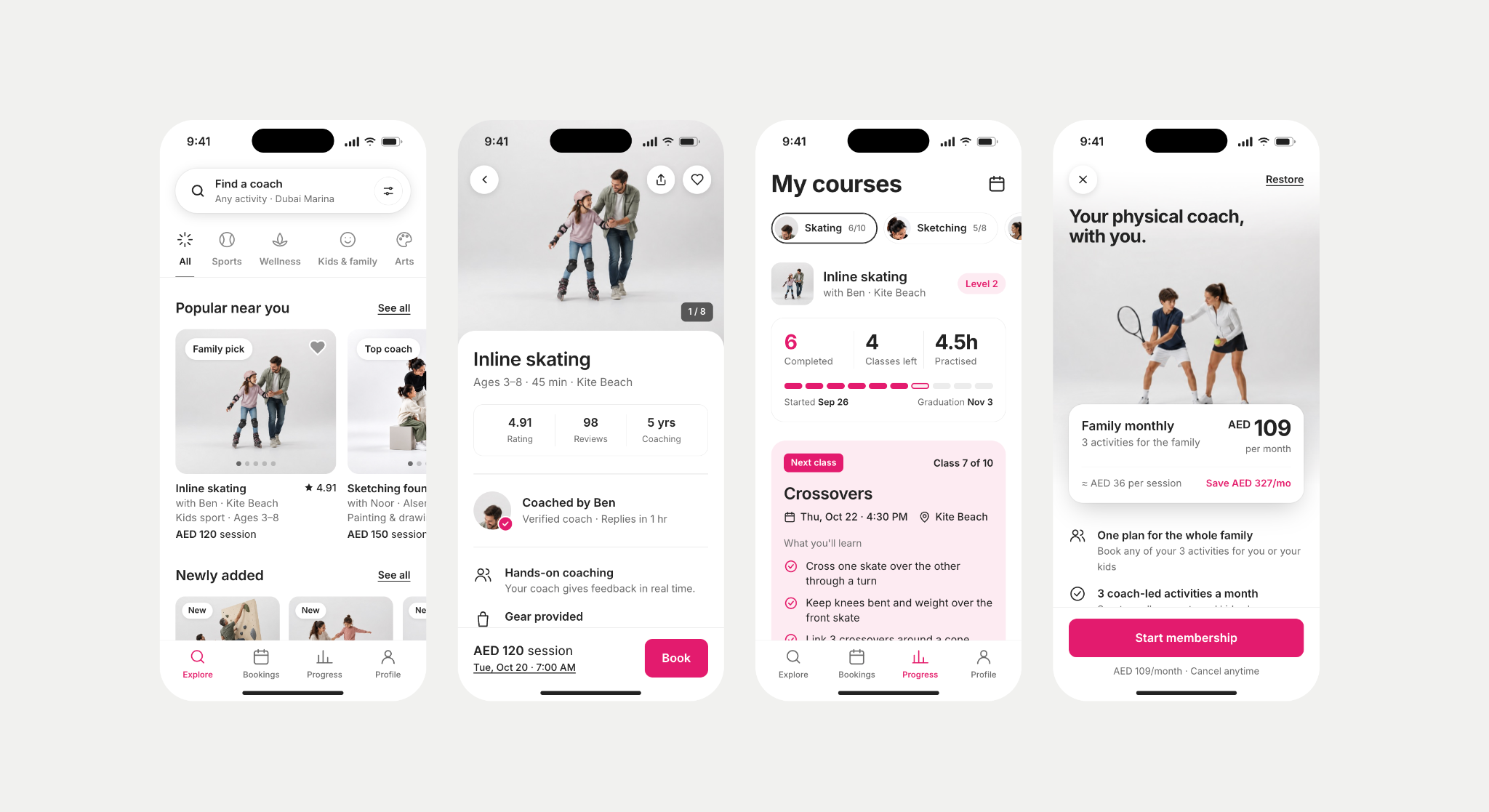
Boxing fundamentals
Available times
GST · 60 minSession type
My courses
Crossovers
What you'll learnFrom your last class
Course plan
Your physical coach, with you.
- One plan for the whole familyBook any of your 3 activities for you or your kids
- 3 coach-led activities a monthSports, wellness, arts and kids classes
- Any coach, any studioPrivate or small group, your choice
- Progress your coach can seeNotes and goals after every session
- Flexible and fairFree rescheduling, cancel anytime
Can kids use my plan?
Yes. Book any kids class under your account, each one uses one of your 3 activities.
What if I don't use all 3?
One unused activity rolls over to next month.
Can I book more than 3?
Extra sessions are billed at the regular per-class price.
Scroll sideways to see more →
Nothing quite like that existed. So I did what every parent does. I asked friends, Googled, scrolled Instagram, sent WhatsApp messages, waited for replies, and hoped I’d picked someone good.
That small frustration led me to a much bigger question.
The question underneath
I started researching extracurricular activities and spoke to a few founders in this space. What stood out was how much people want to learn outside work and school: swimming, skating, football, drawing, music, and more. And not just kids. Adults want to keep learning too.
Demand is growing. Globally, spending on tutoring, youth sports and after-school programmes is forecast to roughly double by the early 2030s.
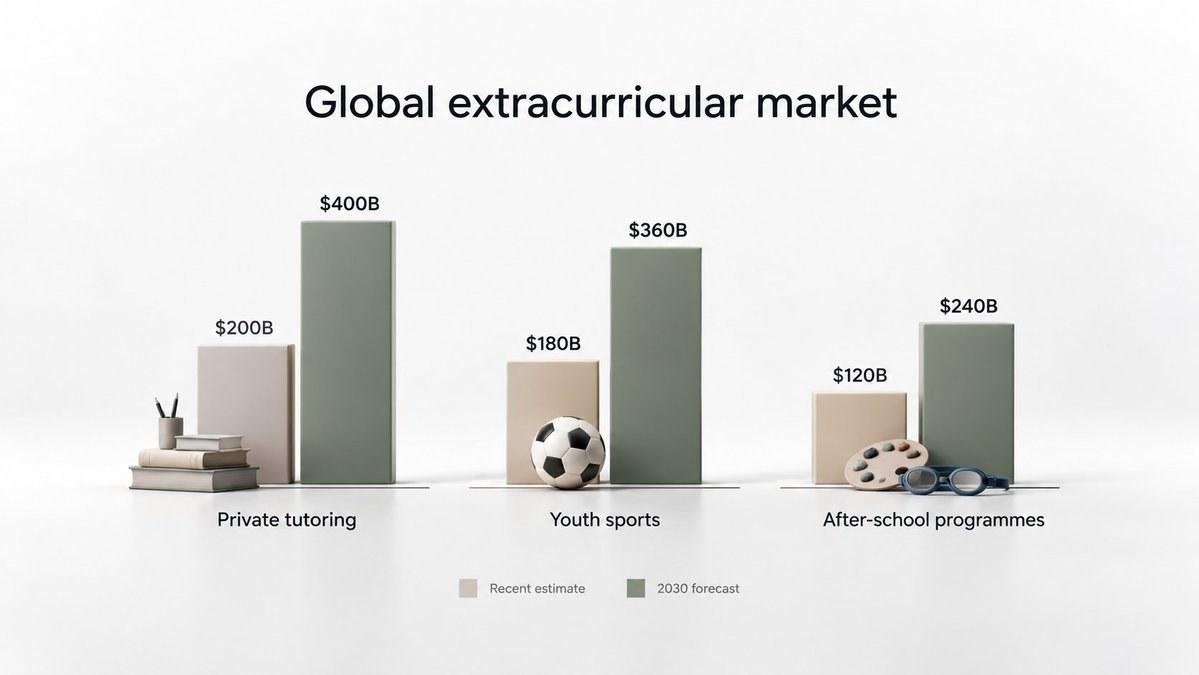
Sources: Global Industry Analysts, Markets N Research, Credence Research. Market-research estimates.
Yet finding the right person still means jumping between profiles, messages and recommendations.
And the further I went, the more one thought kept coming back.
In the age of personal AI
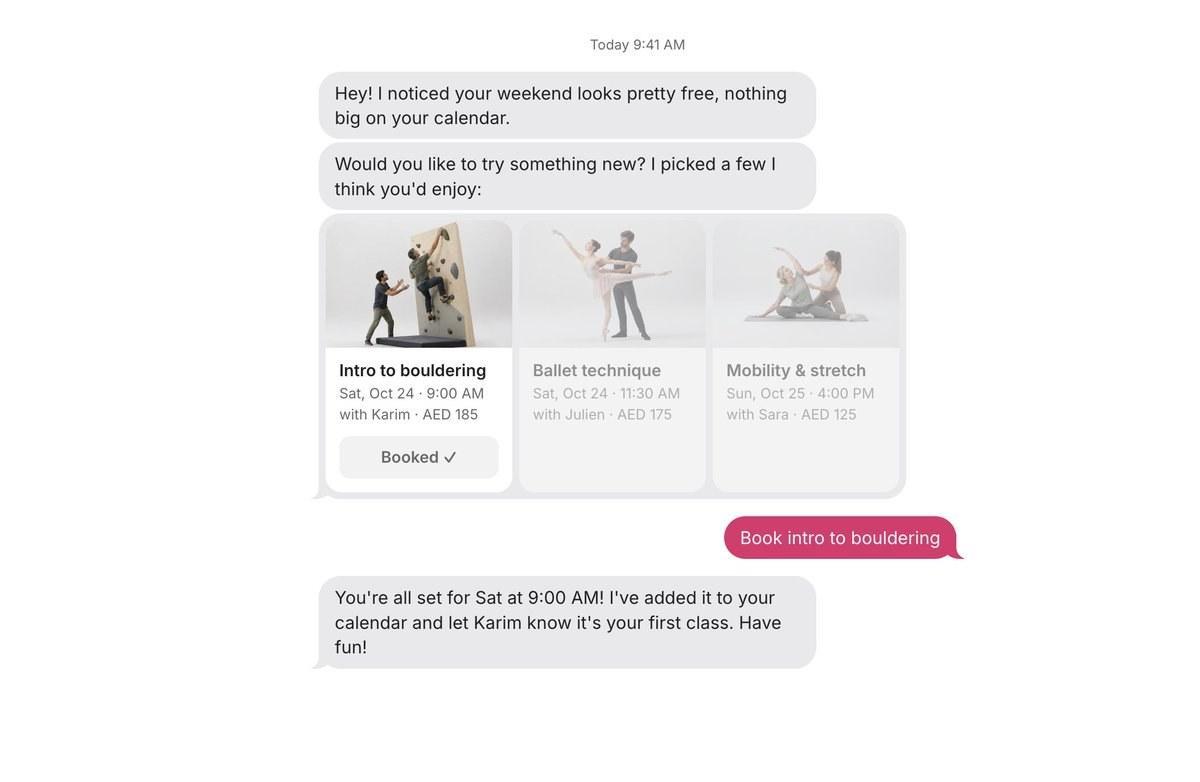
Personal AI is getting very good, very fast. Soon nobody will open ten apps to find a coach. They’ll just ask their AI:
“Find me a skating coach for my daughter, near home, weekend mornings.”
The AI will find someone in seconds. Then comes the real question:
How does the AI know it can trust the person it found?
And underneath that, a bigger one:
How will one human find, trust and exchange value with another human when AI sits in the middle?
Scroll sideways to see more →
How we’ve always trusted strangers
Until now, trust between strangers has mostly come from two places.
Community. A friend recommends someone. A neighbour knows a good teacher. Referrals and word of mouth.
Agencies and marketplaces. You trust the person at your door because Urban Company trained them, checked them and stands behind them. The trust belongs to the platform, not the person.
Both work. But both were built for humans doing the searching, not AI agents searching for us.
An AI can’t ask your neighbour. And it can’t take every platform’s word as equal. It needs a way to check for itself: is this person real, are they qualified, and have they actually done what they say?
What I found while digging
Others are coming at this from different angles.
RentAHuman (@rentahumanx) is exploring how AI agents can hire humans for tasks. Interesting, but that’s AI hiring a person.
Wajo (@wajo_ai) is building AI agents that find, coordinate with and book services on behalf of humans. Boardy (@boardyai) is an AI “superconnector” that gets to know you through a conversation and introduces you to people in its network.
Then there’s World ID, which proves you’re a real, unique human. When AI can generate any face, profile or review, proving you’re real becomes essential.
But being real isn’t the same as being trustworthy.
A real person isn’t automatically a qualified coach. Or background-checked. Or safe to leave with your kid.
Trust is a stack, not a checkbox
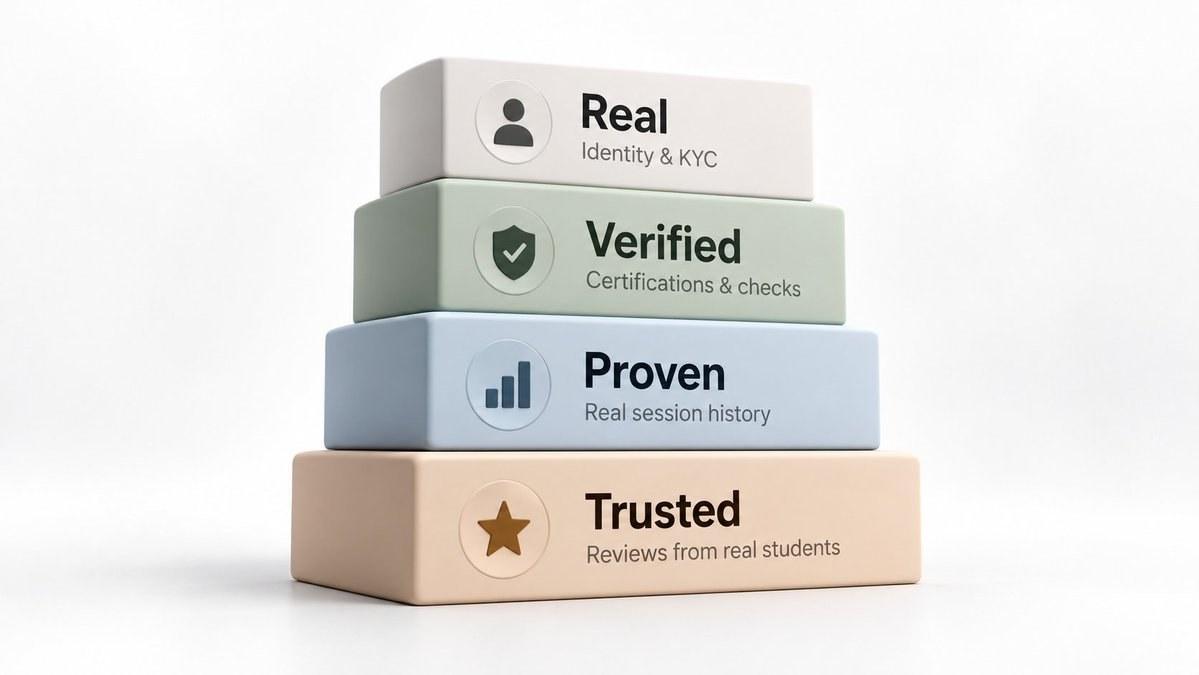
When I sketched out what a trust protocol for human-to-human exchange would need, it came out in layers:
- Is this a real person? Identity and KYC.
- Are they qualified? Certifications and background checks.
- Have they actually done this? Proof that real sessions happened, confirmed by both sides.
- Were they good at it? Reviews only from people who genuinely took the class.
Each layer looks simple on its own. Then real life adds more. Many coaches work through an academy that takes a cut. Some are paid per class, some on a salary, some on a retainer. Gyms run their own bookings and payments. And every country has its own rules: in Dubai, a coach working with kids may need a police Good Conduct Certificate; in the UK, it’s a DBS check.
It isn’t one system, it’s lots of small ones that have to fit together. And when kids are involved, getting trust wrong has real consequences.
How an AI agent actually trusts a human
Here’s the key idea: the AI doesn’t need to trust a stranger. It needs to trust the evidence.
When you ask your AI to find a skating coach, it asks the protocol and gets back proof instead of a profile full of claims:
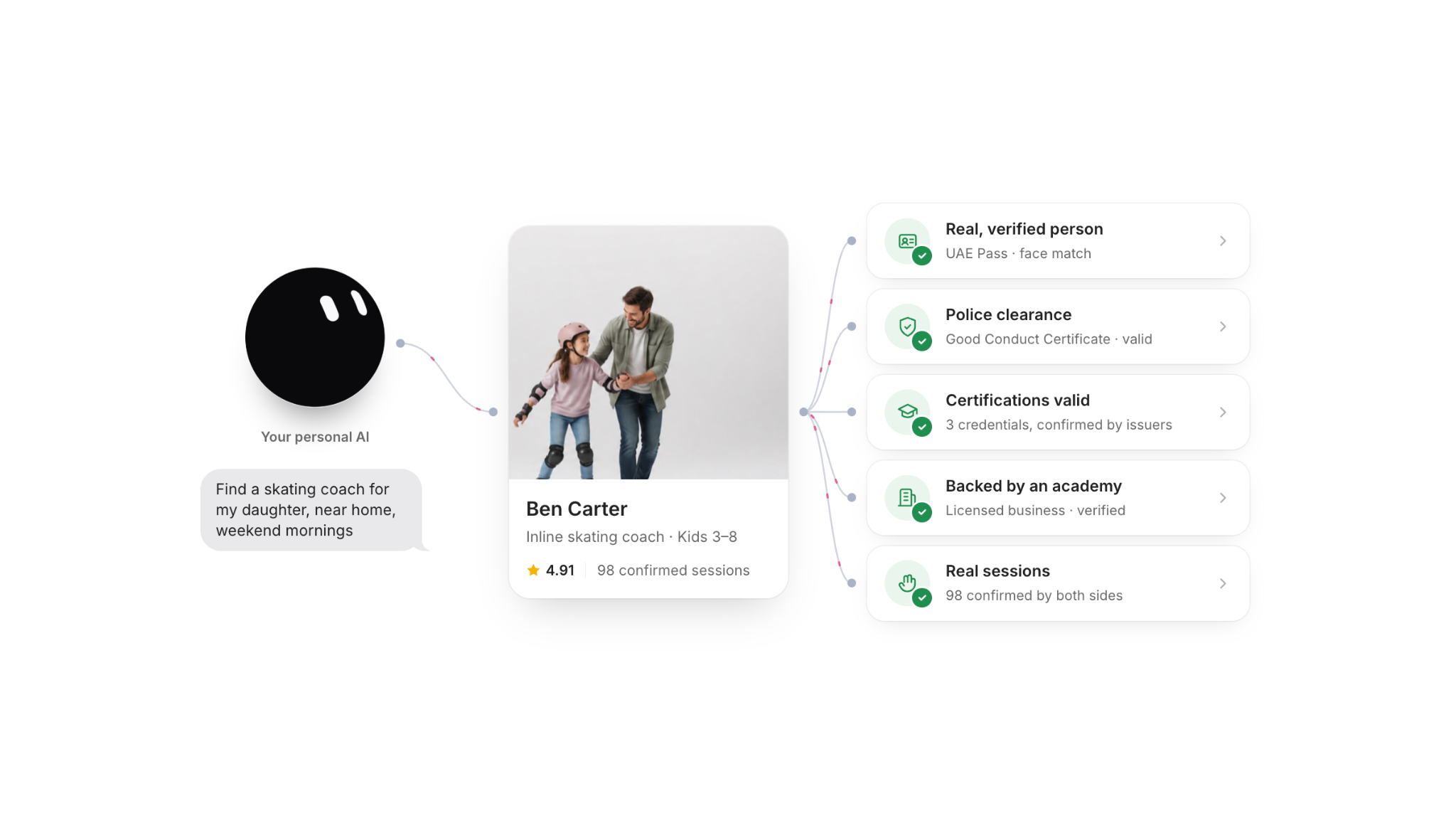

Find a skating coach for my daughter, near home, weekend mornings
Scroll sideways to see more →
- Who they are. Identity checked, and every certificate and background check confirmed by whoever issued it.
- Who stands behind them. Independent, or part of a real, licensed academy.
- Whether they fit the job, here. Coaching a child needs the highest level of verification, under the rules of the country where the class happens. So the AI never suggests an unverified coach for a kid.
- What they’ve really done. Every session confirmed by both sides, so “98 sessions taught” means 98 real sessions.
- Whether it’s still true today. If a certificate expires or a check lapses, the AI sees it right away.
- And you stay in control. Your AI can only book or pay within what you’ve allowed.
Then there’s the money. Your AI pays, but nobody in the middle sits on it. A licensed payment company holds it and releases it only after both sides confirm the class happened. The academy takes its share, the coach is paid on their own terms, and if the coach doesn’t show, you get your money back.
The AI checks, then connects. The humans just show up.
One protocol, many applications
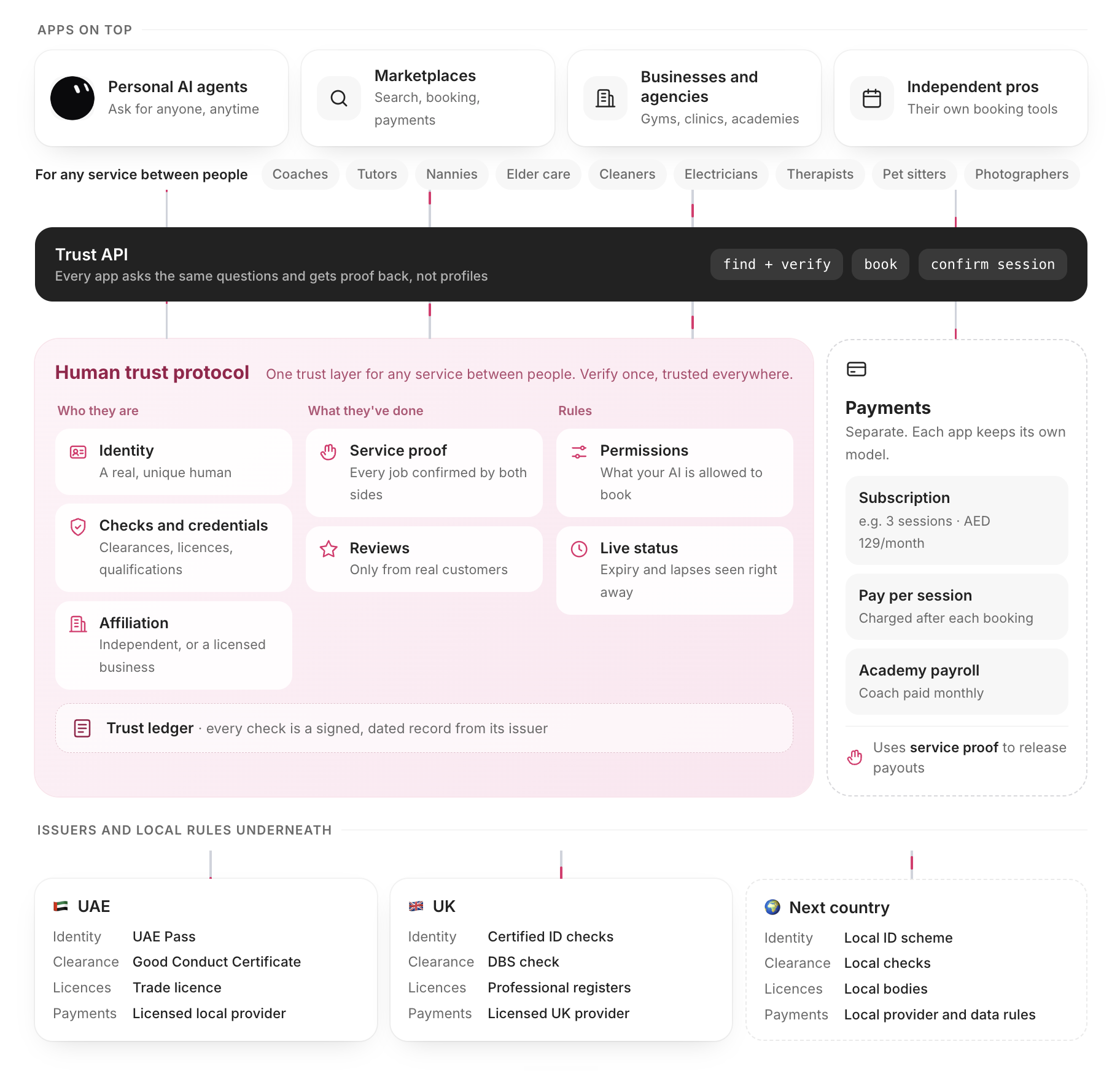
Apps on top
Uses service proof to release payouts
Issuers and local rules underneath
- Identity
- UAE Pass
- Clearance
- Good Conduct Certificate
- Licences
- Trade licence
- Payments
- Licensed local provider
- Identity
- Certified ID checks
- Clearance
- DBS check
- Licences
- Professional registers
- Payments
- Licensed UK provider
- Identity
- Local ID scheme
- Clearance
- Local checks
- Licences
- Local bodies
- Payments
- Local provider and data rules
Scroll sideways to see more →
The way I see it, the trust protocol sits underneath and the applications run on top.
Take a coach marketplace. Today, if you build one, you do everything yourself: check every coach’s identity, certificates and background, collect reviews and convince parents it’s safe. It takes months, and none of that trust moves with the coach when they teach somewhere else.
On a shared trust protocol, the coach verifies once. Their identity, qualifications, real session history and genuine reviews are already there. The marketplace just plugs in and focuses on what it does best: great search, easy booking and a good experience for parents.
The same coach can be found by a gym’s booking system or someone’s personal AI, in any country, and the trust comes along every time.
One layer of trust underneath. Many apps on top, wherever one human needs to trust another: coaches, tutors, nannies, carers, and more.
Human-to-human work isn’t going anywhere. AI won’t replace that. What’s changing is how we find each other. More and more, that connection will run through an AI, and it needs trust we can check, not trust we have to guess.
I’ve started sketching what that could look like, but I don’t know the final shape yet.
If you’re building personal AI agents, I’d love to hear how you see it.